The one-sentence question
Is the source-masked soft X-ray surface brightness at 18–22′ from the nucleus on the northeast side of NGC 1808 higher than the 26–30′ local control in the same new XMM EPIC field, and can such a difference exclude both an ordinary radial decline and projection of the pair environment?
First look at the sky: where the old archive sits, and where the new field would go
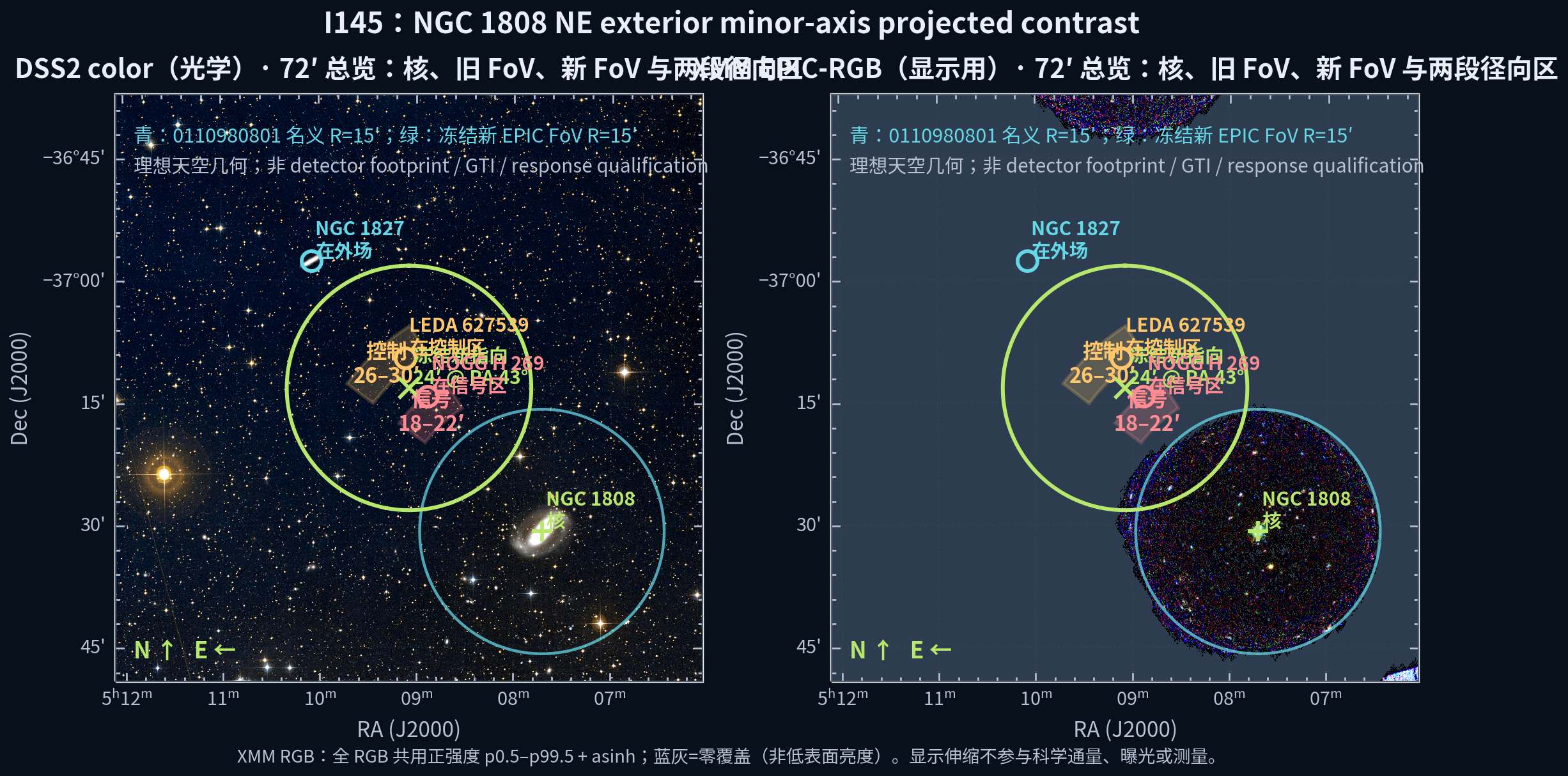
Why would anyone care?
NGC 1808 is a starburst + Sy2 central composite system. If the hot phase driven by central feedback still leaves a measurable projected component at genuinely exterior disk–halo locations, the work connecting central energy injection to the outer hot gas gains a target-level test; if at the achieved sensitivity only an upper limit is possible, it constrains a projected excess above a pre-registered threshold, for this aperture, this band, this sensitivity.
But this is not a "halo yes or no" question, and a single galaxy cannot prove a population-level feedback prescription. A positive result cannot be uniquely attributed to the AGN, the starburst wind, or NGC 1808 itself; a negative result also does not exclude gas that is fainter, hotter, cooler, or outside the aperture.
What number would we measure?
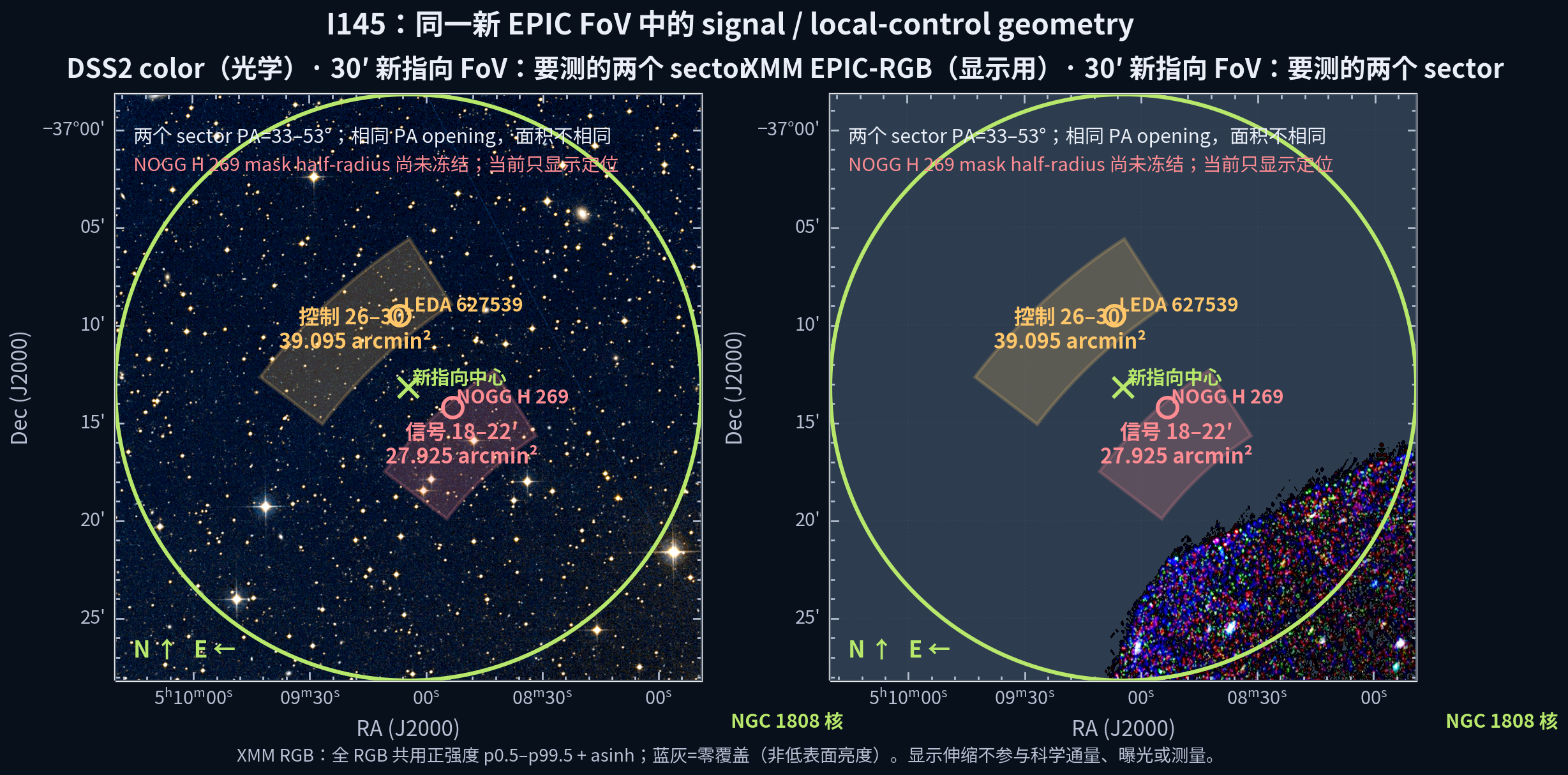
ΔS = S(18–22′) − S(26–30′): the response-folded soft-band projected surface-brightness contrast under the same source mask and source-plus-background likelihood. The two regions share the same PA opening but differ in area; the computation must not treat them as equal-area apertures.
A genuinely readable output can only appear after E1–E4 are all qualified: an interval clearly above the material threshold is an exterior projected excess; an upper limit below the threshold is an exterior projected bound; crossing the threshold is intermediate; failure of geometry, products, or recovery is INCONCLUSIVE.
Key counterexample: an ordinary radial decline already manufactures a positive contrast
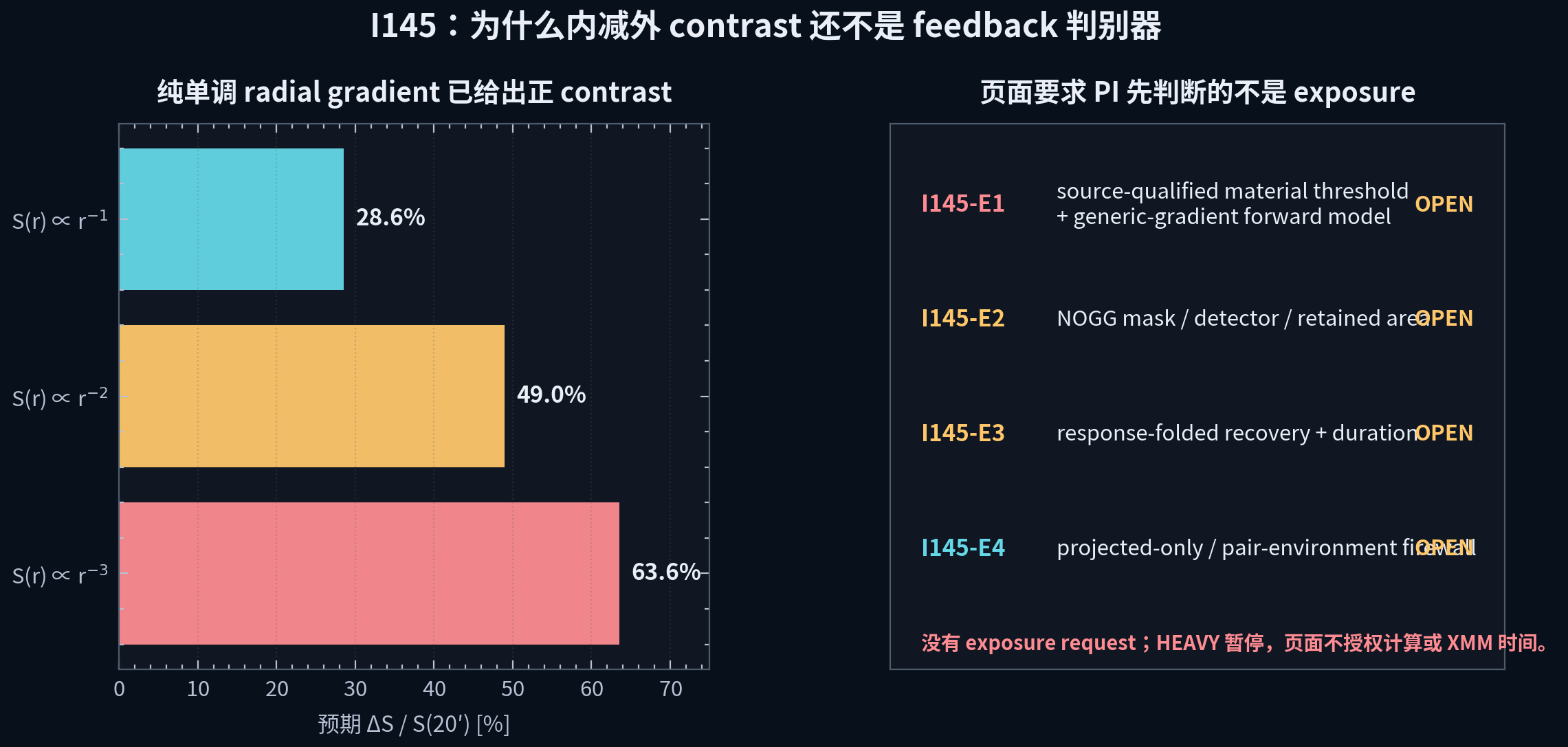
S(r) ∝ r−α, merely because 20′ is more inward than 28′, ΔS/S(20′) is already +28.57% (α=1), +48.98% (α=2), +63.56% (α=3). So "inner is brighter" is by itself not a discriminator for NGC 1808 feedback. Right: all of I145-E1–E4 remain OPEN; this page requests no exposure, nor does it authorize HEAVY or XMM time.What if the answer "comes back the other way"?
Positive value: at most it shows that along this target + pair-environment direction, a measurable contrast exists between this pair of projected sectors; it cannot prove 3-D height, a total hot halo, or feedback origin. Without a generic-gradient forward model and a pair-environment discriminator, a positive value is explainable by any monotonic profile or group structure.
Upper limit: it can only say that at the achieved sensitivity, ΔS in a given aperture / band is below a frozen threshold; it cannot say "there is no hot halo." Before the threshold, detector geometry, or recovery is qualified, the honest label is INCONCLUSIVE, not a physical null.
Costs and unknown costs
The observation shape is frozen as one XMM EPIC pn+MOS Full Frame, THIN1 new field; but there is no exposure request. At this stage there is no clean background, source masks, EEF/vignetting, QPB/SP/CXB/foreground/SWCX likelihood, response-folded recovery, or runtime evidence, so ks, S/N, detection probability, or compute cost cannot honestly be given.
| Gate | What is missing now | Why it affects the PI decision |
|---|---|---|
| I145-E1 | source-qualified material threshold; generic radial-gradient forward model | otherwise the sign of ΔS has no NGC 1808-specific interpretation |
| I145-E2 | NOGG H 269 mask, roll/dither/CCD, retained area | the signal sector could be masked out or contaminated by the group centroid |
| I145-E3 | fixed-seed response-folded recovery and duration | without it there is no verifiable sensitivity or cost |
| I145-E4 | pair-environment / origin firewall | prevents projected pair structure from being written up as NGC 1808 feedback |
What the PI is asked to judge
This design currently has one real but narrow measurable object: the projected radial contrast within the same field. It has not yet demonstrated that this contrast can answer the exterior feedback question, and the CC85 free-wind baseline predicts a surface brightness of about 10−31–10−25 erg cm−2 s−1 arcmin−2 at 49–81 kpc, 10–16 orders of magnitude below the XMM diffuse limit; a detectable positive signal would have to come from an unspecified density-enhancement mechanism. If the PI does not think "first determining whether the contrast exceeds the generic gradient / pair environment" is worth an independent project, it should not be sent to HEAVY.
Page boundaries and reproducibility
- Geometry and gate state:
shared/ideas/I145_ngc1808-exterior-minor-axis-projected-contrast-fork.md. - Display figures: HiPS2FITS WCS cutouts of DSS2 color and ESDC/P/XMM/EPIC-RGB; this bundle's retrieval receipt, figure geometry, and script record the URLs, hashes, and the exact drawing contract.
- This page is a communication artifact: it closes none of I145-E1–E4, constitutes no feasibility or observation-time approval, and authorizes no HEAVY.